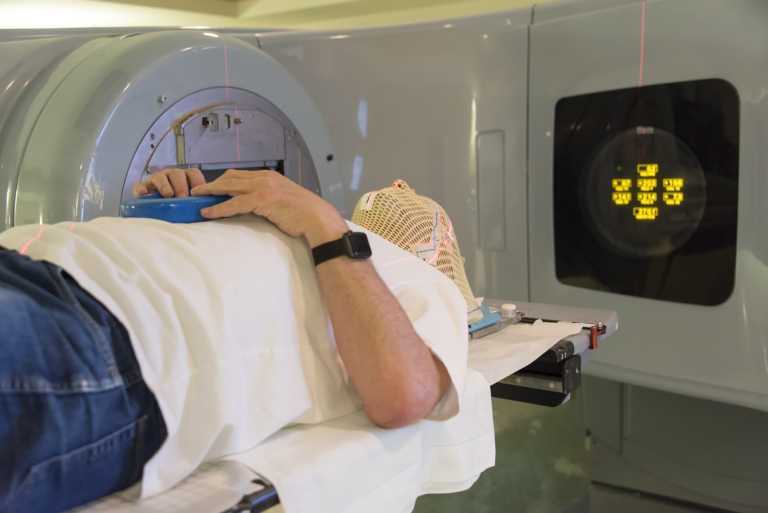

Our private radiotherapy services offer the best treatments available, using the finest expertise, the most modern equipment and cutting-edge techniques, which combine with comprehensive aftercare to seek the best possible outcomes and provide strong support.
A key part of this process is providing individualised care. It is important that each patient receives treatment tailored to their needs, for several reasons:
- Their own age, general health and other circumstances, such as genetic factors, will vary
- Each cancer diagnosis will have its own characteristics, such as differing tumour sizes and locations
- Some cases will be diagnosed at an early stage and some will be later, when the disease may have progressed to a late stage and metastasis may have taken place
- Patients will be involved in the process and their needs and wishes will be taken into account
Apart from this, there is the important aspect of care for each individual as a person, appreciating that undergoing radiotherapy, chemotherapy, or other cancer treatments can be challenging for them and their loved ones in various ways.
The most important thing is to ensure the course of treatment is tailored to individual circumstances, which can be established by initial diagnostics.
What Is The Important New Development Involving PET Scans?
This does not just involve diagnosing a cancer, but establishing facts such as the precise location, size and extent of the disease and whether it has spread through metastasis from its original site to elsewhere in the body.
When planning and then delivering treatment, we use the best methods and devices available, but anyone with even a fleeting knowledge of treatments such as radiotherapy will be aware of the great advances in treatments and the resulting improved medical outcomes.
New developments in technology and medical understanding continue to offer advances and the next one may include the use of PET scans to enable the process of tailoring radiotherapy treatments for brain tumours to be taken to a new level.
According to Physics World, this possibility has emerged with the development of a new form of PET scanner, which uses a multiplex array to display images of more than one radiotracer at a time.
The publication stated that this could enable biologically individualised radiotherapy treatments to be carried out, improving patient outcomes by dealing with the problem of tumour heterogeneity, which involves variations in characteristics within tumours.
Such heterogeneity can pose a problem as some parts are more resistant to radiation than others, but existing scans, with just one screen, can only judge overall resistance, which could then, incorrectly, be assumed to be uniform across the tumour.
With multiple screens, this problem could be resolved, as different scans at different angles can be examined simultaneously, showing which parts of a tumour have higher resistance and where it is lower. This will aid the targeting of radiation in subsequent sessions.
How Can Better Scans Enhance Stereotactic Radiotherapy?
This will help maximise the precision with which the best radiotherapy technology can operate. Stereotactic radiotherapy is designed to do this, with very precise beams of high-intensity radiation.
A prime benefit of this, underlying the invention of the technique and the Gamma Knife tool for delivering it by Swedish neurosurgeon Lars Leksell in the 1960s, is to carry out radiotherapy on the brain and minimise radiation exposure to healthy tissue.
The capacity to focus radiation in this way marked a major advance, but better scanning enables this precision to be taken to even higher levels. Not only can the radiation be delivered more accurately and powerfully, but the targeting can be more accurate.
How Do 3D Scans Improve Radiotherapy?
Multiplex PET scans could add a new scanning advance to those that have already helped to improve radiotherapy. Among these are 3D scans, which enable a clearer picture of tumours and other areas with cancerous cells to be developed.
This is particularly useful when treating tumours with various forms of external beam radiation, as it enables effective targeting to fire beams of radiation at tumours from different angles.
Once again, the fact that there are systems capable of delivering radiotherapy in this way means that modern treatments can maximise the potential for both targeting and delivering radiation from different angles, enabling optimal dosages to be given in the right places.
The use of PET scans may be the next development in scanning technology, but there have already been huge enhancements in this area.
Where once diagnostics depended on biopsies and some guesswork and radiotherapy was relatively imprecise, great strides have been made.
These developments make it increasingly possible to provide tailored treatments, making the way we can respond to your condition truly individual, using the increasing volume and accuracy of scan data and other diagnostic information to plan your programme.
Learn more about our advanced radiotherapy and neurosurgical treatments for brain tumours on the Amethyst Group website.