Thanks to advances in cancer treatment, more people are living longer after a cancer diagnosis.
However, some cancers can spread to other parts of the body, leading to secondary (metastatic) cancer, which may require additional treatment, including radiotherapy
Some cancers, including breast, prostate, lung and bowel cancer, can spread to other parts of the body.
What is a secondary cancer?
Secondary cancer can occur when the primary cancer has spread from the original site to a different location. When cancer has spread to another part of the body, it is classed as stage IV.
It happens when cancer cells separate from the first cluster and migrate, forming what are called metastases.
Cancerous cells do this by moving through the bloodstream and lymphatic system, a process called metastasis.
Secondary cancers are treated according to the type of primary cancer from which they originated, although the treatment approach may differ depending on where the cancer has spread and how extensive it is.
Also called metastatic cancer, secondary cancers can spread and develop in multiple places in the body. These can include:
- Secondary brain cancer and leptomeningeal metastases
- Secondary liver cancer
- Secondary lung cancer
- Secondary bone cancer
Secondary cancers can sometimes develop months or years after successful treatment of the original tumour, even when no cancer is detectable at the original site.
Treatments for secondary cancers can include chemotherapy, hormone therapy and radiotherapy. Treatment plans are highly specific to the individual case and the progression and location of the metastases.
How can radiotherapy be used for metastatic cancers?
Relief from symptoms
If the cancer has spread too far, it may be that radiotherapy is used for palliative measures. For example, if there is pain from a bone tumour, radiotherapy can be used to reduce the size and relieve symptoms.
Reducing pressure
When a tumour is pressing on a nerve, organ or vessel, it can severely impact how your body functions. Using radiotherapy can shrink the cell clusters. This will relieve pressure and hopefully allow a more normal function.
For secondary brain cancer, symptoms often include sickness, headaches and issues with speech and vision. Reducing the pressure caused by tumours in the skull, it reduces symptoms.
Controlling growth
When a diagnosis is at Stage IV, often there is no way to remove all the cancerous cells that have spread. In these cases, radiotherapy and other treatments can be used to slow down the growth of cells.
By doing this, it can improve the prognosis, giving the patient extra time to spend with their family or a better quality of life.
Destroying the metastases
In some cases, when cells have migrated to only a few specific locations, precise radiotherapy treatment can be used to destroy the secondary cancer cells completely.
What type of radiotherapy is used for secondary cancers?
The treatment plan will be tailored to each patient, but there are commonalities between treatments. Certain types of radiotherapy are more suited to metastasised cancers, and radiotherapy is a highly specialised area of medicine.
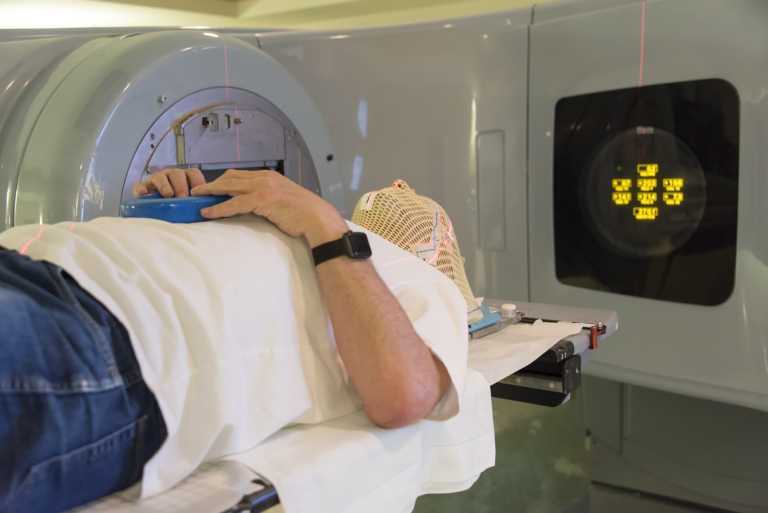
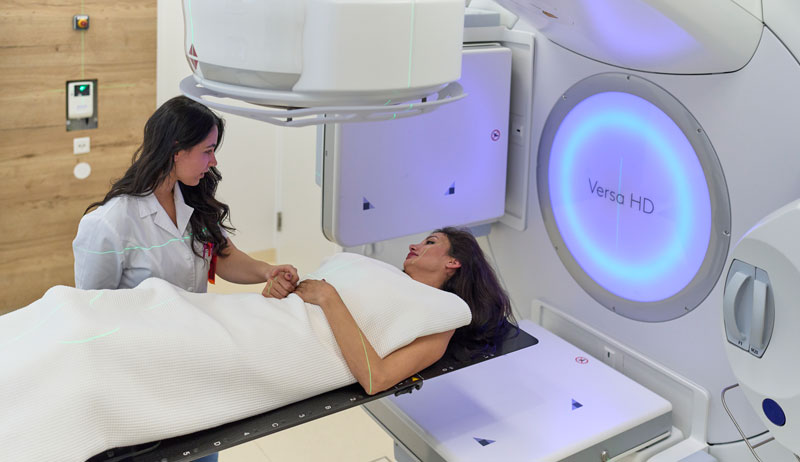
External beam radiotherapy
External beam radiotherapy is targeted therapy aimed directly at the cancerous cells, destroying their DNA and preventing them from replicating. A beam of X-rays or protons is directed at the affected area while avoiding the healthy cells.
Stereotactic radiotherapy
Sometimes called stereotactic ablative radiotherapy (SABR), stereotactic radiotherapy involves a very precise and very intense dose of radiation to a small area. It is a type of external beam radiotherapy, although it is far more focused.
Usually used on oligometastases in organs in the torso, such as lungs or liver, it can also be used on tumours in bones. It can also be used for small tumours in the brain where surgery to remove them would do more damage.
The machine used to deliver this type of treatment is a gamma knife. Although not an actual knife, it is stereotactic radiosurgery involving multiple beams all aimed at the same location.
Whole brain radiotherapy
Unlike gamma knife treatment, whole brain therapy is less precise and is used when the metastases are spread throughout the brain. Its purpose is to relieve symptoms and slow growth rather than cure.
Internal radiotherapy
Internal radiotherapy can be split into two types: brachytherapy and radionuclide. Both use radiation to damage or destroy cancer cells.
Brachytherapy involves the implantation of radioactive substances in the body for a short period. These seeds, wires or ribbons emit radiation that limits the growth of cancer cells, and are removed after treatment is completed.
Radionuclide therapy involves radioactive liquids administered to the patient, which then flow through the bloodstream and destroy cancerous cells.
Both types of radiotherapy impact the whole body and are often used to treat widespread metastases.
To discuss your treatment with us, get in touch with our team for a personalised plan.